Thursday, April 25, 2013

Rhizomucor spp.


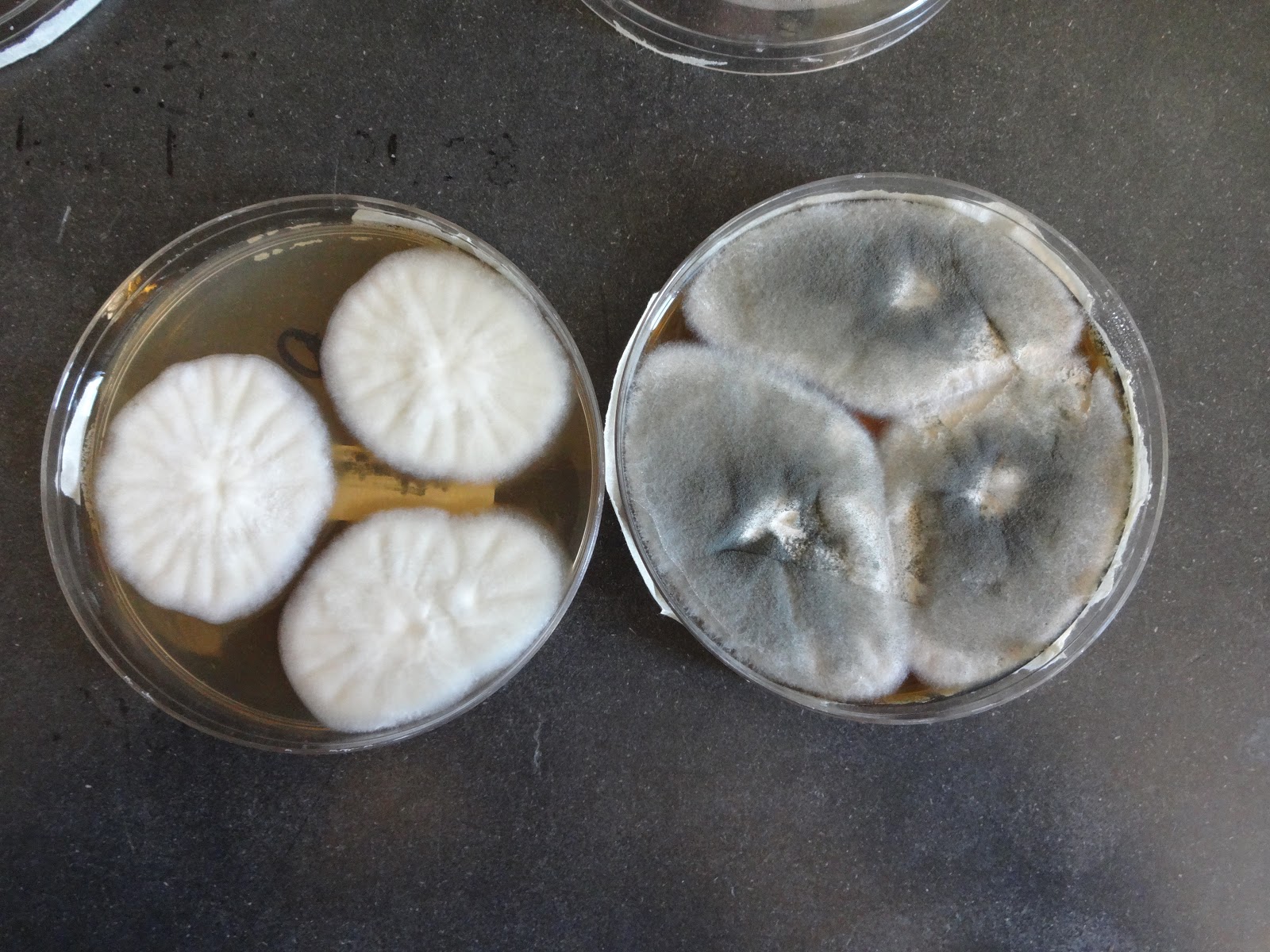
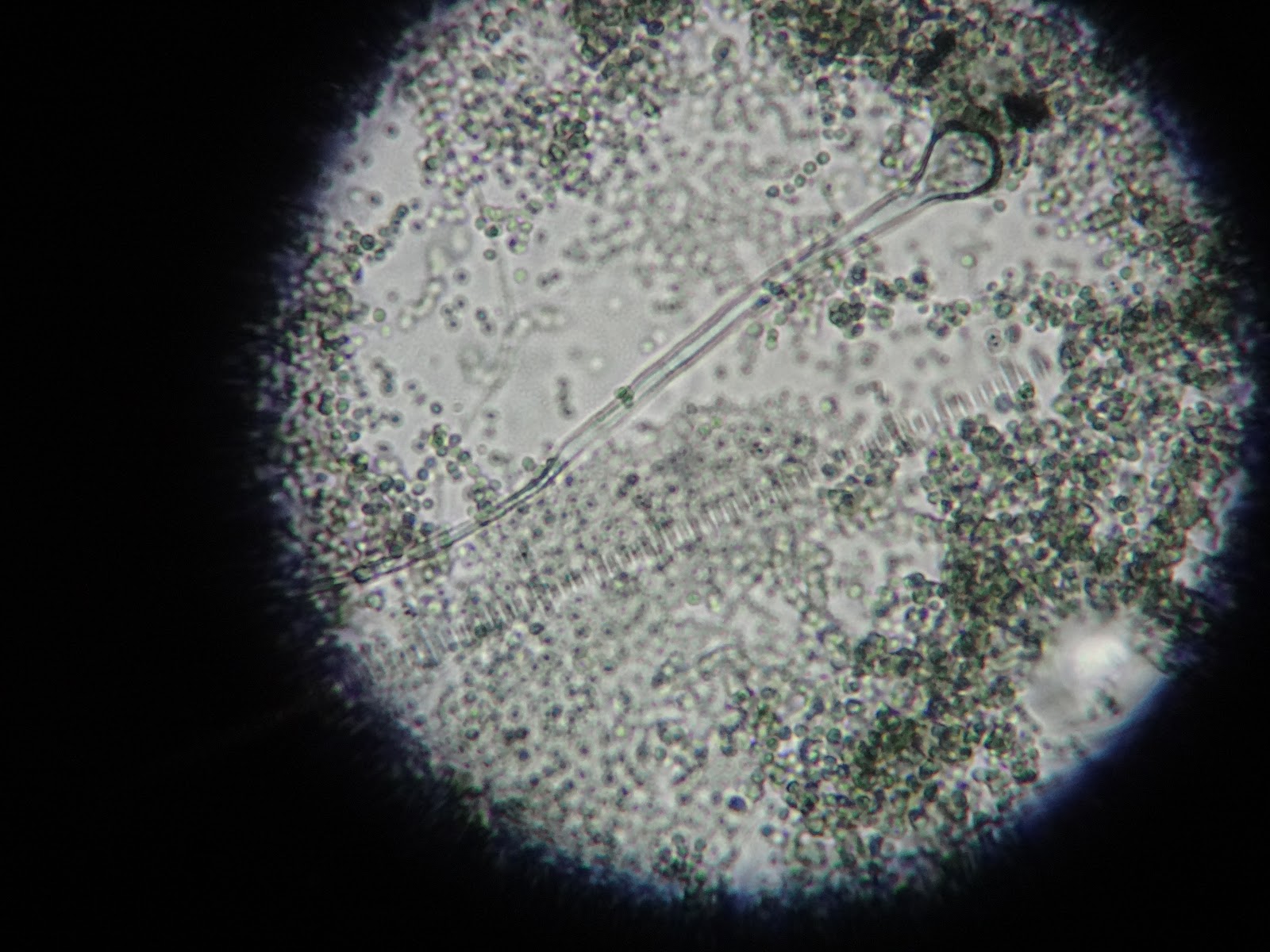
The zygomycete Rhizomucor spp. is an evolutionary mashup of Rhizopus spp. and Mucor spp.  The root structure is much less well developed than with Rhizopus spp.  Several sporangiophores will often converge and not have a rhizoid structure at the base. 

The organism grows well on MEA at both room temperature 25 degrees C. and body temperature 37 degrees C.

Identification by spore trap sampling would be very difficult. 

Rhizomucor spp. - photo N. Carlson

Wednesday, April 24, 2013

Fungal mounting fluid stain recipes

Two rather simple stains make it easier to see the cell walls when preparing a slide to view under a microscope

Lacto-Fuchsin

Add 0.1 grams of acid fuchsin stain to 100 milliliters of 85% lactic acid.  On occasion I find this stain may be a bit strong and diluted it 1/10 with 85% lactic acid. 

Reference: Charmichael, J.W. 1955. Lacto-fuchsin a new medium for mounting fungi. Mycologia 4:611.

85% Lactic Acid

Straight 85% lactic acid is useful for getting a true color image of the fungal spore and structures without staining.  This is helpful for some of the darker colored organisms.

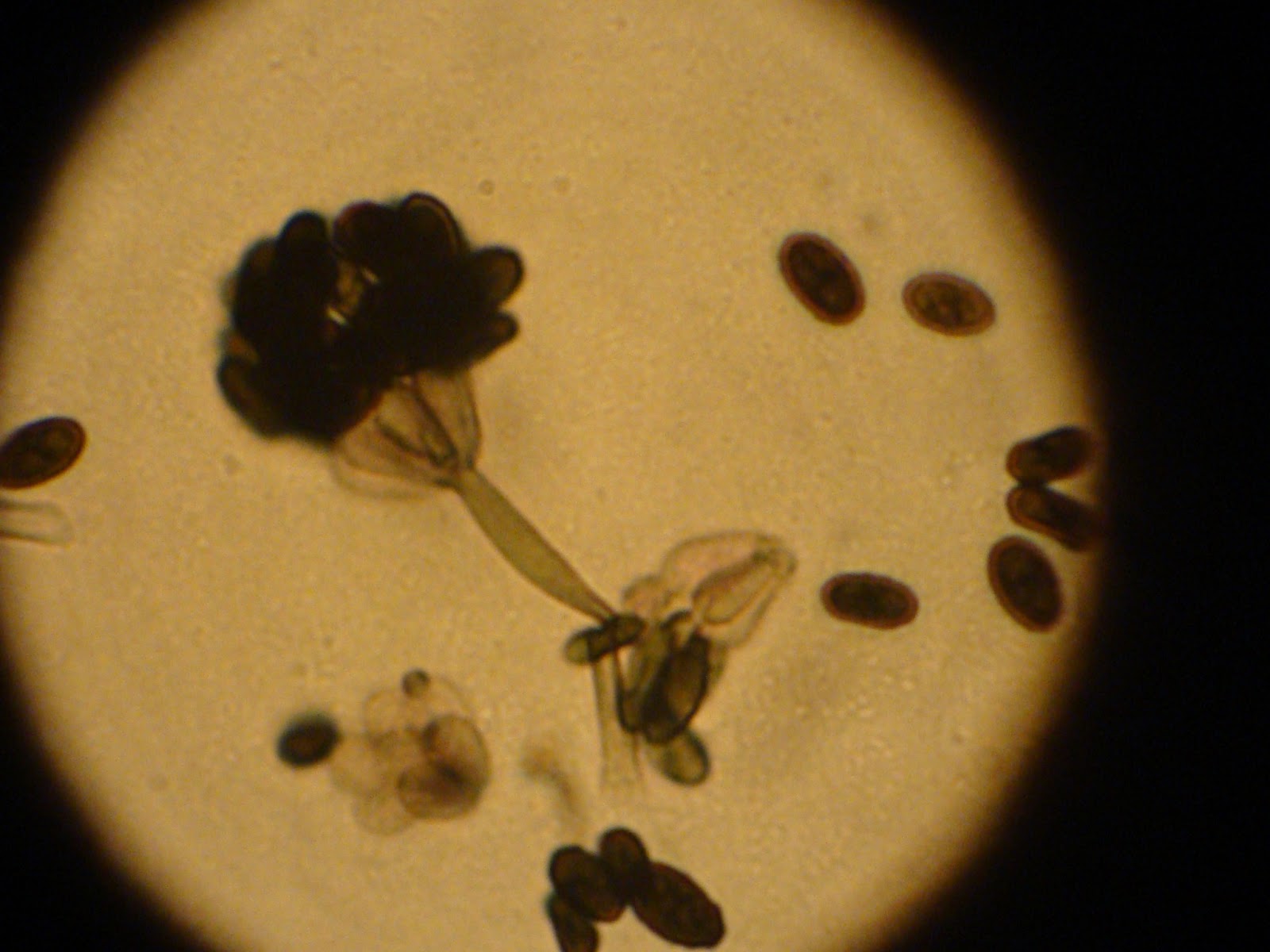
Stacybotrys spp. and Ulocladium spp. lacto fuchsin stain
Stacybotrys spp.  85% lactic acid


Monday, March 25, 2013

Neosartorya spp.

While teaching a class on fungal identification March 19 - 20th, I came across a mislabeled culture.  The organism was classified as Aspergillus fumigatus.  The colony color and growth were all wrong although the microscopic growth was very similar to Aspergillus fumigatus.  The organism is Neosartorya spp. I will attempt to let the colony grow and produce ascospores. 

The conidia would be classified as Asp/Pen like on an Air-o-cell cassette sample.

 
DG-18 Agar and MEA agar growth of Neosartorya spp. 25 degrees C.
 
 
DG-18 agar and MEA growth of Aspergillus fumigatus 25 degrees C.


Neosartorya spp. 85% lactic acid each small tick (2.5 microns)
 
 
Neosartorya spp. 85% lactic acid each small tick (2.5 microns)


Aspergillus clavatus

This unassuming Aspergillus spp. colony produces a very recognizable club shaped vesicle.  The spores are unremarkable and would be categorized as Asp/Pen like for an Air-O-Cell cassette samples.  The conidia are produced on a uniseriate head.  The vesicles become more club shaped as the colony grows older.


Aspergills clavatus on DG-18 agar


Aspergillus clavatus at 100x Acid Fuchsin stain N. Carlson


Aspergillus clavatus 400x (scale: 25 microns between 1 and 2) Acid Fuchsin stain N. Carlson


Aspergillus clavatus - 85% lactic acid stain 400x - N. Carlson


Aspergillus clavatus - lactophenol cotton blue stain 400x - N. Carlson

Friday, March 15, 2013

Syncephalastrum spp.

The zygomycete organism Syncephalastrum spp. can often be initially confused for an Aspergillus spp. under the microscope for people starting out in fungal identification.  Aspergillus spp. are differentiated from this organism because they have phialides and sometimes metulae supporting conidia.  The sporangiophores of Syncephalastrum spp. have vesicles producing long tubed merosporangium containing typically five to ten merospores that break apart as they mature and the merosporangium dissolves.
If the merospore clusters were intact with five or spores linked it may be possible to identify this organism with an Air-o-cell sample.  Otherwise the spore shape would be difficult to differentiate from others.   The organism grows well on MEA at 25 degrees Celsius. The light colored colony and moderate growth makes it difficult to identify by only viewing the colony.
Syncephalastrum spp. growth on MEA at approx. 7 days.
Mature Syncephalastrum spp. merospores - N. Carlson

Syncephalastrum spp.[ heads at various stages of maturity ] merosporangium on vesicles - N. Carlson 400x

Wednesday, March 13, 2013

Sustainable Federal Budget

I've been interested in approaches that bring the Federal Government on a more sustainable path.  France's approach to tax millionaires at 75% appears to be a non starter.  We may need to come up with some new sources of revenue that don't cause people to spend more time avoiding the increase in taxes.


Will Smith - God Bless America 2 - min. 
          
I'd be open to a tax that rate that doesn't care about the source of revenue.  For instance if the maximum tax rate is 25%.  Tax income, corporate, and investment income at the same rate.  This leaves the decision about taxes out of the equation and people are free to focus on the best rate of return for their time and money.

Senator Tom Colburn, MD has produced a very large 600 plus page detailed document Back in Black noting ways the Federal Government can trim the budget without inflicting undue pain on the populace. 


Fix the debt is another group attempting to creatively tackle the problem of an unsustainable government where revenue is not covering expenses. 

I am optimistic that people can work the problem and turn this around. 

Sunday, March 10, 2013

Industrial Hygiene job postings


Nationwide posting for industrial hygiene jobs is available at the American Industrial Hygiene website.

Additional listings are available at EHS careers.com.

This is a list of LinkedIn industrial Hygiene jobs.


What is an Industrial Hygienist? 11 minutes
 
 
AIHA - Industrial Hygiene careers - 8 minutes

Thursday, February 21, 2013

Class on fungal recognition and identification


March 19 and March 20, 2013 - St. Paul, MN, USA Click here for registration information U of MN School of Public Health

This one and a half day training will provide you with an opportunity for concentrated skill development in recognizing and identifying fungi. Using intensive hands-on lab sessions, case studies and presentations, you will learn a systematic procedure for conducting critical analysis of spores in both aerosol samples and in bulk cultures. You will receive one-on-one instruction in laboratory sessions using microscopes to identify fungal samples. You will also receive a photo disk of cultures and the textbook identifying Filamentous Fungi to use for future reference.

Objectives:

1. Describe proper procedures for microscopic examination and identification of selected fungi.

2. Discuss a range of fungal types and potential human health effects.

3. Correctly identify selected fungi under the microscope from both air samples and cultures

Instructors: Neil Carlson and Kelly Mullane

Friday, February 8, 2013

Stachybotrys spp.


The mold, Stachybotrys spp. does not grow well on DG-18  as it needs a higher moisture content.  It has somewhat restrictive growth  on MEA and PDA. When a colony of Stachybotrys spp. is growing in a damp environment the spores are held together in a mass at the top of the conidiophore and do not release well into the environment.  When the spores are dry they are able to be more readily released usually with the help of mechanical forces.

The organism prefers to grow on wet cellulose material.  It prefers an area that has repeated intermittent water damage.  It is often found on a ceiling tile underneath an intermittent roof or  plumbing leak.

The spores are typically approximately 10 -13 microns long by 4 to 5 microns wide.  These spores will settle out rather quickly in the environment and much faster than Aspergillus spp. or Penicillium spp. spores.  Because of this, lower counts of this organism will trigger an investigation to find the source in the environment.

Air-o-cell cassettes or spore trap samplers will work well for sampling Stachybotrys spp. in the environment.  The spore shape (a miniature rugby football) and its dark graphite color make it easy to identify directly under the microscope. 

Stachybotrys spp. dissecting scope  low power
 
Stachybotrys spp. growing in culture
 
Stachybotrys spp. growing on paper from sheetrock.
Stachybotrys spp. conidiophore in culture 400x each division is 2.5 microns wide
 
Stachybotrys spp. spores on a spore trape (Air-o-cell cassette) sample


IAQ video network - Stachybotrys chartarum facts.
 
 
Life cycle of Stachybotrys video