Alexis Madrigal, a writer for the Atlantic Monthly, spoke at the E3 conference at the U of MN McNamara Alumni Center on November 8, 2011. He suggested that we deal with climate change not as an effort to save the planet but as an effort to save civilization. He opened with a photo of a snow storm that shut down New York last winter. If climate change will result in more extreme weather events then there will be a push to slow it down because the extreme weather events make it difficult for civilization to work as designed. Alex is the author of the new book Powering the Dream - the history and promise of green technology.
The blog covers issues broadly related to sustainability in Minnesota and the world both from an environmental perspective and from an interpersonal perspective. It also covers issues related to mycology (the study of fungi) with a specific emphasis on the interaction with fungal organisms and buildings.
Tuesday, November 8, 2011
Sunday, November 6, 2011
U of MN Wind turbine research at Rosemount
On October, 25, 2011 the wind turbines were started at the U of MN U More Park in Rosemount, MN. The turbine will be used to research issues with operating a turbine in a cold climate. Additionally, research into radar interference, ice buildup, wind blade design and wind farm design will be conducted. The turbine will be able to supply energy for up to 600 homes.
Saturday, November 5, 2011
John Bonner's slime mold movies
Princeton University Professor, John Bonner made time lapse slime mold movies. Because the post on slime mold has been the most popular on this blog, I've included a brief movie below.
Thursday, November 3, 2011
Tesla's electric cars sold out for 2012
Fox News reports that the luxury electric car company Tesla has sold out its 2012 electric cars through a preorder system. It had planned to produce 5,000 cars and it has orders for 6,500. The company plans to reveal electric SUV prototype in January, 2012.
![]() |
| Tesla car - photo Fox News |
Cutting the cords on electric cars
New technology is in the works to charge electric hybrid cars without using a plug in. Rachel Kaufman discusses the Scientific American article with NPR's Robert Segal. A specific frequency electromagnetic frequency is used to eliminate problems with magnetic fields and other equipment. It may also be possible to include the charging as part of the roadway but that is in the more distant future. There are also some technical and cost problems to overcome. The home charging is already being tested with a roll out expected within the next ten years.
![]() |
| Photo U of Michigan from Scientific American Article |
GE website on energy efficiency
The Ecomagination web site has a good assortment of information on the latest technological innovations to improve energy efficiency while highlighting new sources of energy. One of the articles highlights Greenstart, a business that provides seed money and mentoring to clean tech start ups in the San Francisco area. Applications for a new round of funding started in October, of 2011.
![]() |
| Greenstart - GE Image |
Sustainable community in Silver Bay, MN
The University of Minnesota Duluth Center for Sustainable Community Development has partnered with the city of Silver Bay, MN to form VICTUS Farms. It is a self sustaining ecosystem using algae, fish tanks and a greenhouse. A power point presentation is available at through Silverbay.com. The ground breaking ceremony took place on October 24, 2011.
![]() |
| The CHP facility at VICTUS - Photo Silverbay.com |
Friday, October 28, 2011
Roger Ruan talk
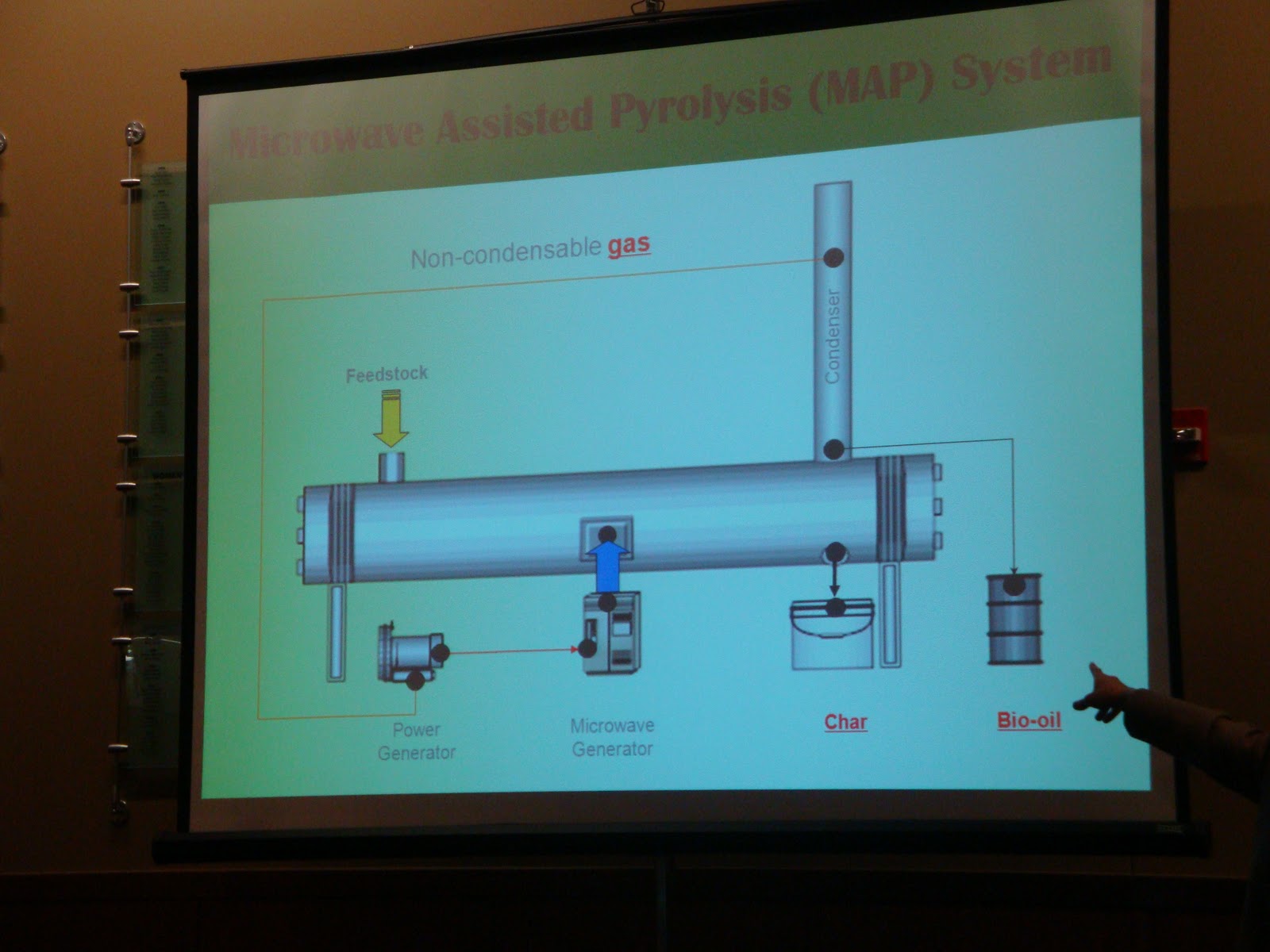
Roger Ruan spoke at the U of MN Health and Safety retreat October 26, 2011, on a possible method for distributed biofuel production from cellulosic feed stocks. Corn stover is the corn stalks produced during corn production. The non edible biomass is plowed back into the ground. Often there is more bulk material than is needed by the soil. Roger's group has developed a microwave process to produce three products a synfuel which can be used as a power generation source, ash which can be used as fertilizer and a mixed biofuel which can be processed into several different fuel types. Moving the bulky cellulose material poses significant cost problems for a centralized processing plant. If the initial processing of the fuel can be done on the farm then the higher energy more compact fuel can be transported to a plant for refining. His group is developing a plug and play mobile processing unit that could be available for rent or purchase by farmers.
Update: This is a pdf of Roger Ruan's talk on Bale to Barrel: Distributed Themochemical Biomass Conversions.
| Microwave Assisted Pyrolysis System - Roger Ruan power point slide |
Cruise ship replaces moldy dorm
St. Mary's College in Maryland will be moving students out a of a moldy dorm and onto a cruise ship. It apparently is cheaper than housing them at a local hotel. Given the propensity for Norwalk viruses to spread in close quarters it will be interesting to see if the students can avoid this fate. This is a link to the CDC fact sheet for Norovirus on cruise ships.
Photo - CBS WJX Baltimore
Mining the moon
Fox News reports that companies are lining up to mine the polar regions of the moon for resources. They are hoping to find a source of natural tritium H3 which would be useful in nuclear fusion reactors. They will also be searching for water and ammonia. It would be helpful information for a future moon base if they can find fuel sources for a hydrogen fuel cell. Either ammonia or water could be used as a fuel source.
![]() |
| Astrobiotic Robot Explorer - Astrobiotic Technology |
Subscribe to:
Posts (Atom)