Monday, April 1, 2019

Mold Remediation Awareness Course May 23 2019


On May 23, 2019 The Midwest Consortium for Hazardous Waste Worker Training -  will be offering a one day Mold Remediation Awareness Course at the University of Minnesota - East Bank Campus. Instructors are Mike Buck, Neil Carlson, and Sean Gabor.

Mold remediation courses provide an overview of activities involved with mold remediation and are designed to train individuals who are or who anticipate being employed at a mold remediation work site.

Activities in this courses could include sampling techniques available to find hidden mold and the limitations of these techniques, how to identify the most common fungi related to water damage and health hazards, methods to prevent water events and mold growth in buildings, emergency response plans, protective equipment, and control containment or confinement.

Additional site-specific training for emergency response must be provided so individuals can carry out any role, which may be assigned during a response.

Cost: $225 - Continuing Education Units Provided 

Registration call 612-624-2345 or 612-626-2596  web site: hazmat.umn.edu 

Thursday, March 7, 2019

Exploring the fungal breakdown of reheated lunches

Lunch dish left out for too long.

Forgetting to immediately clean a lunch dish provides an easy way to grow a variety of fungal organisms without using a culture plate. Both Rhizopus spp. and Aspergillus niger have dark colored spores. The Aspergillus niger conidia are uniformly round. The Rhizopus spp. sporangiospores have an irregular walnut shape.

Aspergilllus niger

Rhizopus spp. 

Penicillium spp. with Rhizopus spp. sporangiospores and Aspergillus niger conidia. 

Monday, January 21, 2019

Speaking Science - Media Panel

Graphic recording by Amy Sparks of  A Visual Spark (1/17/2019)
Moderator Elisia Cohen (Hubbard School Director) asked Timothy Blotz (Fox 9 news anchor) and Michelle Cortez (Bloomberg News) to explain the keys to successful communication between scientists and journalists.

Preparation prior to the interview is key. This allows the scientist to make sure they are communicating accurate information. In some situations, it is acceptable to politely refuse to answer questions if the news media misrepresents their stated intentions and questions are about topics that are not fully researched.

Tips from the notes above: Test out your ideas to regular folks prior to talking with the reporter, and be prepared to share what is important to you. Know the controversy well and address it directly. Let the audience know why they should care. Promptly contact the news director for factually incorrect information so a correction can be made to the web post.

Practice with a podcast or talking with others to get comfortable in front of the camera. A good news reporter will do what they can to put their interview subject at ease. If you are super shy, you can refer the reporter to another scientist who is more comfortable in front of a camera.


Timothy Blotz interviews Amazing Race winner Dr. Natalie Strand - 4 min. 

Speaking Science - Communicating Science in a post truth era by Amanda Stanley

Graphic recording by Amy Sparks of  A Visual Spark (1/17/2019)
Amanda Stanley from Compass offered up suggestion to communicate effectively in a "post-truth" world.  Passing false information through the media has been going on since at least the 17th Century. False news often spreads much faster than real news so it is difficult for the truth to catch up.

Changing people's minds with facts does not work. People want to bury the opposition with facts, destroy them, and sometimes end up being a jerk. Asking people to change their beliefs often requires them to change who they are. This usually does not happen.

Extending curiosity to find out what people care about and where there is a common interest can be a productive starting point for discussion. Connect to people with shared values, build trust, and share the awe of scientific discovery.

During her talk audience members watched a brief video on the Speaking Science improv for scientists mini-workshops held throughout the year.  I was fortunate to attend this class and found it to be very helpful and a great learning experience. Working on improvisation for scientists improves interpersonal and communication skills. Alan Alda advocated this in his book, If I Understood You, Would I Have This Look on My Face?


Christine O'Connel, The Alan Alda Center - Improv. in Science - 13 min. 


Alan Alda - Relating Through Improvisation - 5 min. 


Improvisation for the Communication of Science - Alan Alda - 14 min. 

Speaking Science - Talking to the public and legislators

Graphic recording by Amy Sparks of  A Visual Spark (1/17/2019)

After an introduction by U of Minnesota President, Eric Kaler, a faculty panel of Michael McAlpine Assoc. Prof. Mech. Eng.) , Jane Kirtley (Prof of Medical Ethics), and Kristina Krohn, MD (Assoc. Prof Med.) responded to questions posed by moderator Chris Cramer (V.P Research).

Panelists offered several recommendations to assist with clear communication of scientific discoveries.

  • Adjust the message to the audience.
  • Share the excitement of your research.
  • Establish credentials with rapport, humility, truth, and caring.
  • Repeat the same message in slightly different words.
  • Know the facts.
  • Know that reporters often focus on the negative.
When dealing with legislators, use anecdotes over data, establish relationships with the legislative staff, offer a message they can share, and admit when you don't know an answer to a question. 


Current issues facing journalists - Jane Kirtley - 8 min. 


Tissues and electronics in a 3D printed "bionic ear" - Michael McAlpine - 7 min. 

Speaking Science - Curiosity as a Catalyst by Emily Graslie

Graphic recording by Amy Sparks of  A Visual Spark (1/17/2019)

On January 17, 2018 Emily Graslie delivered the keynote address at the Speaking Science Conference at the University of Minnesota. Emily is the chief curiosity correspondent at the Field Museum of Natural History in Chicago, Illinois. She originally started as a landscape painter who fell in love with the objects in the zoological Museum at the University of Montana.

On a three day trip to the Field Museum of Chicago to film episodes for her Brain Scoop YouTube channel, the Field Museum staff offered her a job to work there.

Emily's advice to scientists is to identify your audience, use the language your audience uses, and modify the tone based on the audience. Brain Scoop made two separate videos on speciation. They produced the first video for a senior high school and freshman college audience. The second video used candy to represent species with middle school students as the target audience.


Candy Taxonomy - Emily Graslie presentation

Emily let her curiosity guide her career. She stepped out of her narrow role as an artist and moved into unexplored territory that gave her greater meaning.

Sample Science Scoop Videos below.


Meet Emily Graslie - Chief curiosity correspondent - Field Museum - 6 min.


Rodents of Unusual Size - 7 min. 


What is the Function? - an engineer attempts to guess the function of animal parts - 8 minutes


The Value of Curiosity - Emily Graslie - TED Talk - 13 minutes

Monday, December 17, 2018

Interesting Milk Dehydration Product


Dried milk - N. Carlson

At the bottom of a glass of milk that spent too much time in a bedroom this spongy object formed. It looks like a sunny side up egg.  It appears to consist of dehydrated milk solids.

Bottom side of dried milk - N. Carlson
The underside is hollowed out. I attempted to grow portions of the material on culture plates, TSA, DG-18 and MEA. The plates were placed in a 25C incubator. There was minimal growth on the plates other than yeast.


Monday, August 20, 2018

Ground Cherries

Ground cherries from U of MN farmers market - N. Carlson

Inside ground cherries from U of MN farmers market - N. Carlson

I purchased the ground cherries because I used to eat them when I was younger. As I was eating the cherries, I noticed two with dark spots on them. Tease tape samples were taken from the surface of the cherries and the inside of the outer cover. Both insects and Cladosporium spp. fungal growth were noted.

Insects on the Cherries 40x

Growth of Cladosporium spp. and insect part - 400x

Saturday, August 18, 2018

Minnesota Wildflowers

U of Minnesota - Near Civil and Mineral Engineering Building - N. Carlson

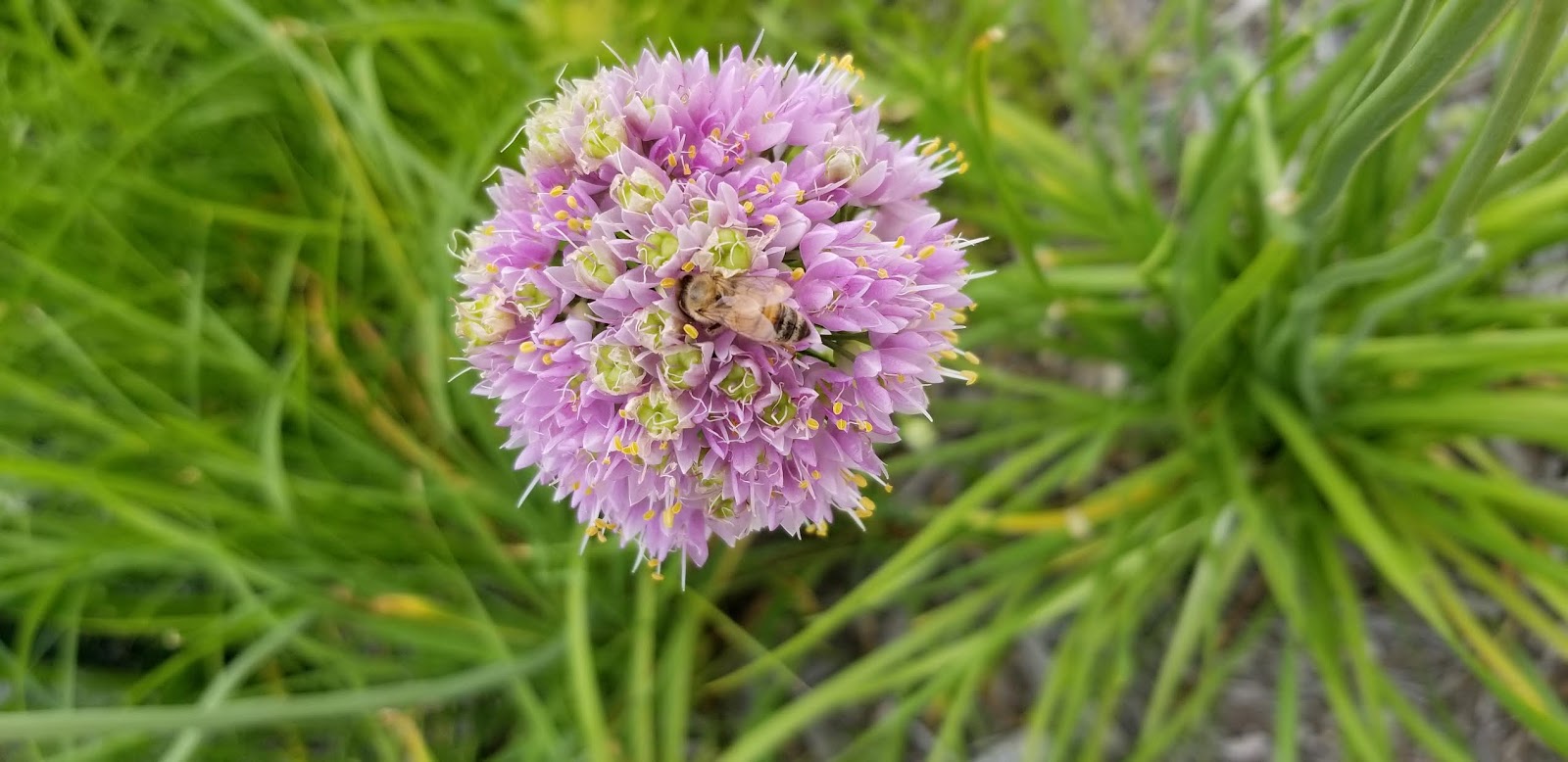
The University of Minnesota and regional park boards continue efforts to bring back native prairie grasses and flowers. The efforts appear to be successful based on the colorful flowers in the landscape and the wide variety of insect pollinators.

The spaces with the native grass also do not require weekly mowing, extensive watering and herbicides to keep the area free of weeds.

Male monarch butterfly in wildflowers by TCF Bank Stadium - N. Carlson
Efforts to bring back the population of monarch butterflies need more than milkweeds for the caterpillars.  The butterflies need nectar for energy and these flowering plants also need to be planted in the area.

Beetle and bee on wildflower at Silverwood Park in St. Anthony - click to enlarge - N. Carlson

Honeybee on flower at the St. Paul Campus of the U of Minnesota - N. Carlson

Flowers also provide an excellent habitat for bees. At one planting outside McNamara Alumni Center five different types of bees were busy extracting nectar from the flowers.  I used some of these images in this book published in December of 2018. 


The paperback version of Fireworks, Flowers, Forests, and the Minnesota State Fair: Image Reflections from Minnesota is available from Amazon.  There is also a kindle version of Fireworks, Flowers, Forests, and the Minnesota State Fair: Image Reflections from Minnesota that is best viewed from a portrait orientation.

The video below uses some of the wildflower images from this the book.


Minnesota Wildflowers - Wildflowers Music by Tom Petty - 3 minutes14 seconds

Wednesday, August 8, 2018

Hearing Conservation for a Cheap Trick Concert

Cheap Trick at the North Dakota State Fair - July 26, 2018 - N. Carlson
Sound levels at rock concerts exceed the OSHA occupational exposure limit for noise exposure (90 dBA averaged over 8 hours).  As the effect of hearing loss is irreversible, it is prudent to bring along hearing protection to these concerts. At the Cheap Trick Concert the drum was heavily miked. The beats on the base drum felt like chest compressions for CPR.

Rick Nielsen and his special guitar. - N. Carlson
How loud is too loud? Average exposure above 85 dBA over eight hours requires hearing protection. Sound level meter apps on phones are fairly good but they are not calibrated. As a rule of thumb, if you are in an environment where it is difficult for you to hear your finger snap at arms length, it is prudent to wear hearing protection.  Many hearing protectors now come in metal cases that can be attached to a key chain. Some are also designed for better tone quality to hear music at concerts.


These Ear Peace ear plugs worked well with three colored inserts that provide varying levels of hearing protection. The metal key chain case  allows for the storage of the three ear pieces in one compartment and the inserts in another. 


The Flame - live-  Cheap Trick 1988